

In conversation with Cow Tools
Maeve de Bordóns Álvarez
September 2026
Cow Tools is a DJ, writer, and editor based in NYC, originally from Virginia. Inspired by the forest parties she helped throw while living in Oxford, she began DJing herself after moving to New York, where she found a home in Brooklyn's underground techno scene. Cow Tools moves effortlessly between spaces and sounds, through words and music. Drawn toward writing and DJing in pursuit of a similar feeling and attentive to the ways her practices feed one another, Cow Tools moves effortlessly between spaces and sounds, through words and music.
As well as being a DJ, you are a poet, do you find parallels between writing poetry and putting together a DJ set for a party?
One of my favorite parts of DJing is crafting a narrative arc in a set. Many of the considerations are the same in writing—across all the temporal arts, really. I think a lot of poems, not just sonnets, have a kind of volta, or turn, and a lot of good DJ sets do, too. A lot of my favorite collections have a kind of double-ending—a penultimate poem that feels final and then what I conceive of as a “coda poem” that comes after. You can see how thinking about these narrative shapes transfers across art forms. I work in publishing, and putting together a set feels similar to editing a book, thinking, No, this isn’t an engaging enough intro, what else can go here? Or, Here’s the kind of thing that has to happen first for this ending to have its intended effect. One of the classic pieces of writing advice is that you want to make choices that feel surprising but inevitable, and this applies perfectly to DJing.
Where did the name Cow Tools come from?
It’s a reference to a cartoon from the comic The Far Side. You can read about it here, but to summarize: It’s a cow standing in front of a table with some strange lumpy tools, and it just says “Cow tools.” Readers were baffled to the extent that Gary Larson, the creator, made a public statement explaining the joke. He said, “The cartoon was intended to be an exercise in silliness. While I have never met a cow who could make tools, I felt sure that if I did, they (the tools) would lack something in sophistication…” I was sitting there with my beginner controller on the table in front of me and felt very much like that cow in the picture. I wanted a name that was a little bit silly but could also be serious—or at least the silliness wouldn’t always be in your face.
You grew up in Charlottesville, Virginia - how was it growing up there, and what are the first memories of art?
Charlottesville is a small college city at the foothills of the Blue Ridge, not far from Appalachia and a couple of hours from DC. I was born there, and by my late teens, I felt eager to see somewhere else, but I really treasure having grown up there. Charlottesville had a number of educational arts programs while still feeling very small, which made it feel like you could explore everything. A lot of my early meaningful encounters with art were very local. The University of Virginia’s art museum ran an annual ekphrastic writing contest—ekphrasis is writing inspired by other forms of art, traditionally visual art—and kids in the area would go on field trips to tour the museum and then write a story or poem based on one of the works. I think I first went in third grade, and I’d look forward to it every year as I grew up. It was my first time being asked to discern what works of art I found inspiring and why, and then do something about it. It was the first thing that motivated me to write outside of school and to take my writing seriously. It’s maybe not a coincidence that, when I studied English at uni, my research focused on ekphrasis and cross-genre work, and that I continue to look sideways to other art forms for inspiration.
How did growing up in Charlottesville influence your taste in music?
As a teenager, I listened to a lot of indie rock, and then I got really into folk punk and anti-folk—bands like Defiance, Ohio; Kimya Dawson; Jeffrey Lewis; Diane Cluck, who lives in Charlottesville. I was drawn toward the subculture and community I found through writing, and similar things spoke to me in the music I liked. It felt like the right music for the landscape and the particular sense of yearning that I grew up with. I was really into a certain kind of cynical humanism; I was really into new sincerity; I was really into music that seemed to tell a story; I was really into music that was delivered with some harsh sense of urgency. Listening to music felt very private at that age. I would listen while running or walking through the woods behind my house. But then when someone liked the same music, it was this groundbreakingly intimate shared experience. The first show I went to was The Mountain Goats at the Jefferson Theater in 2016. And it was like, of course, this is what live music is for, to have this shared experience side by side.
I didn’t come to dance music until years later, and my first clubbing experiences were in Europe. When I started listening to techno, it felt like it offered me different things. With the music I’d listened to up until that point, more of the feeling in my body comes from my brain; with the dance music I like, more of the feeling in my brain comes from my body. The throughline that made me latch onto both was this feeling of sustained tension, this straining toward something inarticulable, which is one of the things I have always been most drawn to in art. And how the techno scene is full of people looking for an emotionally intense, sometimes transcendental, shared experience. There’s a similar combination of beauty and grittiness, too. I close my LBM mix with a free-folk song from the Portland band Jackie O Motherfucker. I wanted to end in a way that would bridge the different feelings I get from the music I love.
When you lived in the UK, you helped organise underground forest parties - how did that shape your sound and way of approaching DJing?
It was the first time I’d experienced being a part of a scene, partying in a place I lived rather than as a tourist. I was living in Oxford, which is where I helped with some party crews, and going to London a lot. People were really welcoming. I’d played around with the idea of learning to DJ before, but being part of such a rich DIY scene really motivated me. It’s different seeing a famous DJ play an amazing set versus seeing your friends play amazing sets, and the latter is more inspiring. Sound-wise, I was absorbing a lot more psy sounds than were in the club music I’d previously listened to. Partying in the forest probably had something to do with this.
Living in New York now, how has New York shaped your music taste?
It’s interesting how much physical space impacts taste. In NYC, we’re partying primarily in studios and warehouses around Brooklyn, and a lot of the techno I’ve been into lately sounds like someone’s dragging furniture around in the apartment above. My taste really reflects a blend of machinistic and organic sounds, accumulated from the different settings that have shaped me.
Also, as with my time in the UK, it’s hard to separate how the city has affected my taste from the specific experiences I’ve had with my slice of the scene and the people in it. I’ve found some really wonderful pockets of the scene here, and a number of peer emerging DJs whose work I really admire. In all things, I grow the most when I’m working in conversation with others, so that’s been awesome.
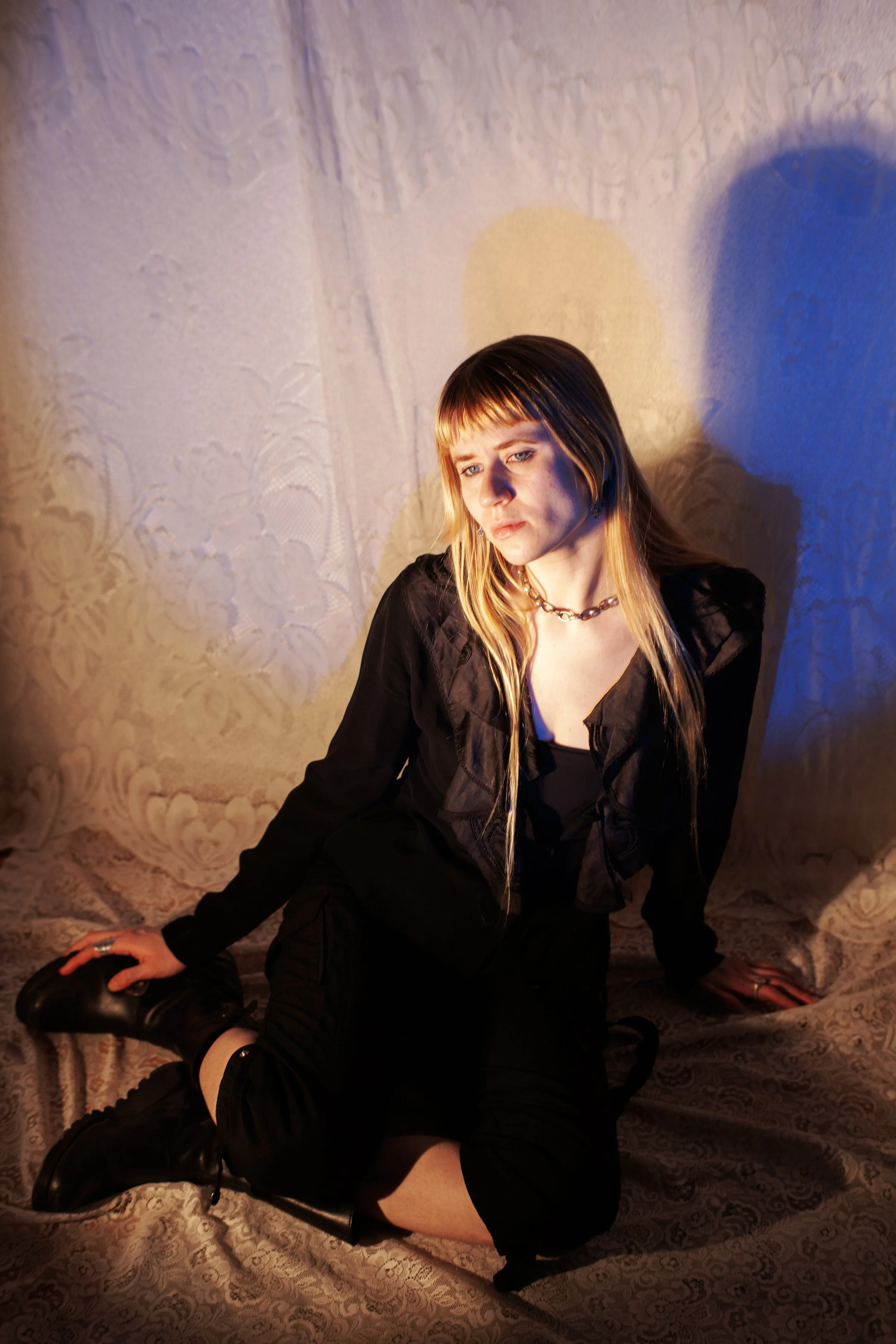
Cow Tools by Diana Hardage
What is your favourite part of living in New York?
When I feel most fulfilled by my everyday life, the reasons are very specific. Like, my favorite part of living in New York is dancing with the friends I’ve made on the dance floor, talking about my day with my wonderful roommates, doing work at the cafe near my house. In many ways, New York is the most difficult place I’ve lived; there’s so much here, but it’s difficult to find a decent apartment, everything is expensive, everyone is pressed for time. But it gets better and better as you figure out your rhythms. I love my rhythms now. And I love that it keeps getting better and better.
What makes a great party?
My dance floor attitude is that dancing is a competitive sport, but it’s a team sport, and everyone’s on the same team. We’re all trying to make the party the best it can be. If you see your teammates lagging, you should dance in a way that energizes them, that pulls them back into the music. If you’re lagging, you should think about whether you need a break on the bench. The idea that we’re all creating something together is true not just of the dance floor but of the whole party. I think what’s most important is that the crowd has some awareness of this, whether explicit or not. When you see people using their phones for too long in the middle of the dance floor, or cutting to the front but not dancing—it’s because they aren’t seeing themselves as collaborators, aren’t at least somewhere in the backs of their minds trying to further the atmosphere. There’s even a way to lose yourself as part of this larger project. I think the best parties are the ones where everyone recognizes that they can play a part in the project and feels gratified by it. In this way, being in the DJ booth and being on the dance floor aren’t that different.
What are some labels and parties you love, and that you would love to share with the world? (In NY and beyond)
Some of my most memorable nights dancing in NYC have been at Heat Index, Hybrid Identity, Earth Dog (now Loop), and Dripping’s club nights. I’ve recently loved playing for Vortex Brooklyn’s party series Area X and R-DNA’s radio show and party series TXR. You and I met through Jezebelle, who runs Collective Hysteria—their parties in London were really inspiring for me. A few labels I love are Varia; DONKER; Mama Told Ya; Mutual Rytm; Molekül; techlab.bp; and Orientation, which is pretty new—my friend does the visual design, and they’ve put out two releases so far, both fantastic.
What are you currently reading?
Recently Stoner by John Williams made me cry on an airplane. Now I am reading Natalia Ginzburg’s essay collection The Little Virtues and Jackie Wang’s poetry collection The Sunflower Cast a Spell to Save Us from the Void.
Keep up with Cow Tools on Instagram, Soundcloud or their website.
Tracklist
Big Mama - Molecule
Melancholic Therapy - Catartsis
Malt - Rill
Dance - Yanamaste
The Lawnmower - Ikari
Phobia - GCOD
Nightwalk - Specific Instructions
Copper - Mython
IIIIIIIII1IIII2IIIIIIIII - Valentino Mora
Blank Room (Sira Remix) - GCOD
Echo Tunnel - Kaan Pirecioglu
Bass Track - Yanamaste
Endless Love - Vinicius Honorio, Theo Nasa
Commodore - DJ Dextro
DONT PLAY 065 (IGLO Remix) - Toro Ikemoto
All My Girls Are On The Floor - Jon10
Preservation - Mython
4PM Snacks - Anetha, Hadone
Deine Augen - Maeksll
Final Fantasy - MCR-T
Rockaway - Jackie O Motherfucker